
Area Real Estate News & Market Trends

You’ll find our blog to be a wealth of information, covering everything from local market statistics and home values to community happenings. That’s because we care about the community and want to help you find your place in it. Please reach out if you have any questions at all. We’d love to talk with you!

Nov. 9, 2021

Budgeting for Major Construction Projects


Maybe you’re adding an expansion onto your home, constructing a standalone storage building in the back yard, or undertaking some other major construction project. Whatever it is that you’re building, you likely already know that big construction jobs can carry big costs. If you haven’t budgeted for the job correctly, though, you might end up surprised at how big some of these costs can be.

Sticker shock for construction projects can be a problem, but it doesn’t have to be. With a little bit of thought and planning, you can make sure that you’ve got all your expenses covered in your budget before the job begins. While some of the costs involved will be very specific to the details of your construction project and where you live, these budgeting tips will help you to keep an eye out for things that can drive the price tag up, so you can account for everything.

Major Expenses

Some of the costs of major construction projects are obvious: You’re going to need money to cover things like lumber, siding, wiring, and other materials. You’re also going to have to pay your contractors and laborers for the work that they put into actually doing the construction. If you aren’t paying attention, however, these costs can get away from you and leave you with a bit of a surprise when the bills come due.

Many material costs fluctuate based on supply and other factors and may be affected by things like transportation costs as well. Lumber prices in particular are prone to fluctuation and can increase significantly if supplies are disrupted. If possible, get in a purchase order or otherwise get some sort of pricing guarantee before work starts so that you can lock in a price and protect yourself from price shifts down the road.

Posted in Home Maintenance
Nov. 8, 2021

Experts Project Mortgage Rates Will Continue To Rise in 2022


Experts Project Mortgage Rates Will Continue To Rise in 2022 | MyKCM

Mortgage rates are one of several factors that impact how much you can afford if you’re buying a home. When rates are low, they help you get more house for your money. Within the last year, mortgage rates have hit the lowest point ever recorded, and they’ve hovered in the historic-low territory. But even over the past few weeks, rates have started to rise. This past week, the average 30-year fixed rate was 3.14%.

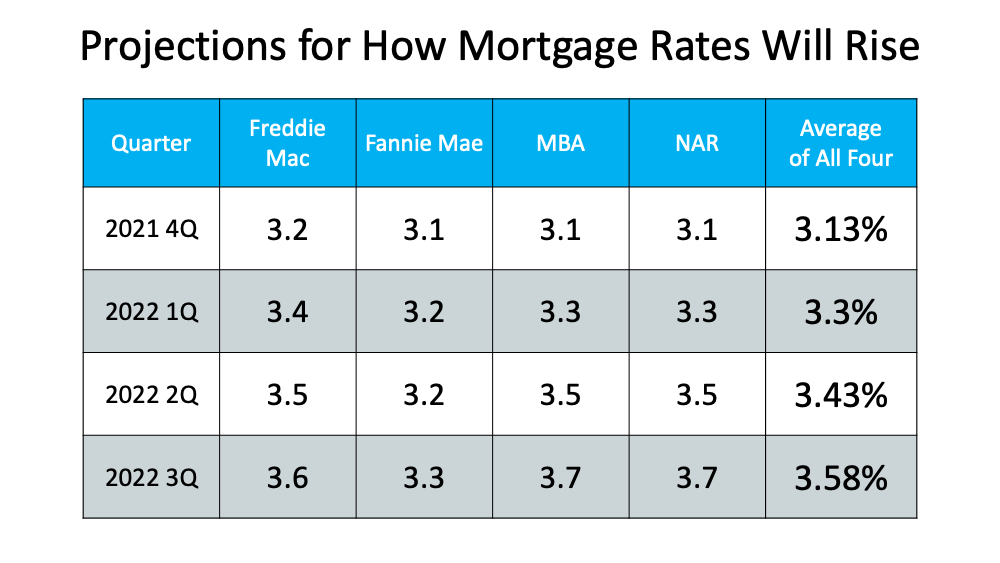
What does this mean if you’re thinking about making a move? Waiting until next year will cost you more in the long run. Here’s a look at what several experts project for mortgage rates going into 2022.

Freddie Mac:

“The average 30-year fixed-rate mortgage (FRM) is expected to be 3.0 percent in 2021 and 3.5 percent in 2022.”

Doug Duncan, Senior VP & Chief Economist, Fannie Mae:

“Right now, we forecast mortgage rates to average 3.3 percent in 2022, which, though slightly higher than 2020 and 2021, by historical standards remains extremely low and supportive of mortgage demand and affordability.” 

First American:

“Consensus forecasts predict that mortgage rates will hit 3.2 percent by the end of the year, and 3.7 percent by the end of 2022.”

If rates rise even a half-point percentage over the next year, it will impact what you pay each month over the life of your loan – and that can really add up. So, the reality is, as prices and mortgage rates rise, it will cost more to purchase a home.

As you can see from the quotes above, industry experts project rates will rise in the months ahead. Here’s a table that compares other expert views and gives an average of those projections:Experts Project Mortgage Rates Will Continue To Rise in 2022 | MyKCMWhether you’re thinking about buying your first home, moving up to your dream home, or downsizing because your needs have changed, purchasing before mortgage rates rise even higher will help you take advantage of today’s homebuying affordability. That could be just the game-changer you need to achieve your homeownership goals.

Bottom Line

If you’re thinking of buying or selling over the next year, it may be wise to make your move sooner rather than later – before mortgage rates climb higher.

Posted in Market Updates
Nov. 5, 2021

There Are More Homes Available Now than There Were This Spring


There Are More Homes Available Now than There Were This Spring | MyKCM

There’s a lot of talk lately about how challenging it can be to find a home to buy. While housing inventory is still low, there are a few important things to understand about the supply of homes for sale as we move into the end of the year.

The Number of Homes for Sale Usually Peaks in the Fall

In the residential real estate market, trends generally follow a predictable and seasonal pattern. Typically, the number of homes available for sale (or active monthly listings) peaks in the fall. But in a chapter where so little feels normal, the question becomes: should we expect a fall peak this year?

If we look at the active monthly listings for 2021 (shown in the chart below), we’ll see that the number of homes on the market has increased fairly steadily since spring this year. The realtor.com data shows we’re still seeing an increase in active inventory month-over-month. While that gain is a bit smaller month-to-month (see August to September in the chart), September numbers are still up from the month prior.There Are More Homes Available Now than There Were This Spring | MyKCMThe important takeaway here is the latest monthly numbers show growth. At the end of September, buyers had more options to pick from than they did this spring. That’s encouraging for buyers who may have paused their search months ago because they had trouble finding a home. Danielle Hale, Chief Economist at realtor.com, sums this up nicely:

“Put simply, this September buyers had more options than they've had all year and while that's typical of early fall, that's not what happened in 2020. Still, it's important to remember that while buyers may have an easier time this fall than they did in the spring, the market remains more competitive than it has been historically at this time of year.” 

As Hale says, a fall peak in inventory is in line with typical seasonal trends. While it’s impossible to say for certain what the future holds for housing inventory, we do know both buyers and sellers have opportunities this season based on the latest data.

What Does That Mean for You?

If you’re thinking of buying a home, rest assured you do have more options now than you did earlier this year – and that’s a welcome relief. That said, today’s market is still highly competitive. This isn’t the time to slow your search. It’s actually the season when the number of homes available for sale tends to peak. Focus on the additional options with renewed energy this season and be prepared for ongoing competition from other buyers.

If you’re considering selling your house, realize that while growing, inventory is still low. Selling now means you’ll be in a great position to negotiate with buyers – and competition among buyers is good news for your bottom line. Eager buyers will likely be motivated to act before the holidays, giving you the benefit of a fast sale.

Bottom Line

Whether you’re buying or selling, there’s still a chance to make your goals a reality this season. Let’s connect so we can discuss what’s going on with the local market and current trends and what they mean for you.

Posted in Market News
Nov. 4, 2021

Cleaning Your Toughest Patio and Deck Stains

After a long summer, it’s time to clean up around your home and get everything in good shape before the winter comes. Not only does this sort of fall cleaning help your home look nice after the rain and heat of summer, but it can also aid you in finding issues or damage that you might want to take care of as you winterize your home. Some areas that often need particular attention during these cleanup periods are patios and decks.

Part of the reason for this is that many people use their patios and decks more during the summer than at any other time of the year. Various spills, dripping grease and oils from grilling, and assorted other messes can end up on the wood, while changes in weather over the course of the summer can encourage the growth of things like algae and mildew. Knowing how to effectively clean up all of these stains and other issues will not only make your deck or patio look better, but can also result in them lasting significantly longer without needing repairs.

Deck Stain Removal

Effectively cleaning up the various stains that occur on your deck or patio becomes a lot easier if you know the source of the stain. Grease stains, sauces, and similar spills can usually be cleaned with dish soap and a stiff-bristled brush, followed by washing the area thoroughly before it has a chance to start drying again. Dish soap can also be used to remove stains from decomposing leaves; allow it to sit and penetrate for 10 or 15 minutes before scrubbing and rinsing the stains away.

Other types of staining may require different solutions, however. Rust stains may need to soak in a mix of water and white vinegar or specialized acid cleaners to remove the discoloration. Tree sap can also be stubborn and difficult to remove, often needing dedicated deck or patio cleaners or cleaning solutions such as liquid oil soap cleaners. Some stone patios may require specific cleaners that won’t damage the type of brick or stone that’s used as well.

Posted in Home Staging Tips
Nov. 3, 2021

Your Home Equity Is Growing [INFOGRAPHIC]

Your Home Equity Is Growing [INFOGRAPHIC] | MyKCM

Some Highlights

  • If you’re a homeowner, today’s rising equity is great news. On average, homeowners have gained $51,500 in equity since this time last year.
  • Whether it’s funding an education, fueling your next move, or starting a business, your home equity is a great tool you can use to power your dreams.
  • Ready to sell? Let’s connect to talk about how you can take advantage of your rising equity to reach your goals.
Posted in Market News
Nov. 2, 2021

Year-Round Savings With Ceiling Fans

In general, people tend to think about air conditioners as a way to keep a home cool and heating units as a way to keep it warm. There’s nothing wrong with this line of thinking, of course. If you’re only relying on heaters and air conditioners to maintain the temperature, though, then you may be spending way more than you need to keep your home comfortable.

One key part of controlling your home’s heating and cooling costs that you might be ignoring is the humble ceiling fan. By using ceiling fans effectively, you can keep your home at more consistent temperatures throughout the year while spending a lot less on heating and cooling. If you like the thought of staying comfortable while spending less, here’s what you need to know about using your ceiling fans effectively.

Proper Fan Usage

If you’re using ceiling fans in your rooms throughout the year, it’s important to make sure that the fans are placed properly. Ideally, you should have fans placed near the center of the room they’re installed in, hanging around 7 to 9 feet from the floor with around a foot clearance between the fan and the ceiling. Large fans are best so long as they work with your room layout and don’t interrupt your décor; as they have larger blades, they can move more air at once even when running at lower speeds and will save you more money than smaller fans.

During the summertime, you should have your ceiling fans spinning in a counterclockwise direction to create the desired windchill effect to keep things cool. When possible, you should also close curtains and blinds to prevent sunlight from heating up the air as well. Once temperatures start to drop and you turn on the heat, flip the switch on your ceiling fan so that it starts spinning clockwise to circulate the air without the windchill. Open up the blinds and curtains as well, letting in that free heat from the winter sun.

Posted in Home Keppr
Nov. 1, 2021

The Mortgage Process Doesn’t Have To Be Scary [INFOGRAPHIC]

The Mortgage Process Doesn’t Have To Be Scary [INFOGRAPHIC] | MyKCM


Some Highlights

    • Applying for a mortgage is a big step towards homeownership, but it doesn’t need to be one you fear. Here are some tips to help you prepare.
    • Know your credit score and work to build strong credit. When you’re ready, lean on your agent to connect you with a lender so you can get pre-approved and begin your home search.
    • Any major life change can be scary, and buying a home is no different. Let’s connect so you have an advisor by your side to take the fear out of the equation.
Posted in Market News
Oct. 31, 2021

Is It Time to Cut Down Your Tree?

Autumn is a good time to do a number of things around the house. You’ve likely already started preparing for winter, trimming back some of your plants, and doing other maintenance tasks that are perfectly suited for brisk fall days. There may be at least one big task that needs to be done that you haven’t even considered, though: cutting down that tree that you’ve been worried about for ages.

It may seem strange to think of a project as major as cutting down a tree as especially well-suited for autumn, but there are actually a few reasons why this is the perfect time of year to bring that tree down. If you’re on the fence, here’s some advice on how to tell whether the tree really needs to come down and how to make sure that you bring it down safely.

Why Autumn?

Though bringing down a tree can be done at any time during the year, there are a few reasons why you should give it extra consideration during autumn. Cutting down a tree in the fall can help prevent regrowth, as the sap will rise during the day and then can freeze during the cold overnight and kill the roots and stump. Even if it’s not cold enough to freeze, the fall cutting will weaken the roots and remaining stump and greatly decrease the likelihood of regrowth.

This isn’t the only reason to cut down trees in the fall, though, and not even the most important reason. If you’re cutting down a tree, it most likely has significant damage or disease and will become a hazard eventually if it isn’t already. Dead and damaged trees are much more likely to fall or split during the winter as water penetrates the damaged sections and freezes; cutting down the tree in the fall prevents this from happening, giving you control over when and how the tree falls instead of leaving it up to chance.

Inspecting Your Tree

When trying to decide whether a tree needs to be cut down, there are a few things that you should look for. Significant damage to the tree is a big one and one of the most obvious; this can be storm damage, lightning strikes, or other types of damage, and should be pretty obvious just from looking at the tree. Splits, cracks, and holes in the trunk revealing that at least part of it is hollow make this sort of damage very obvious. At the very least you should remove damaged or dead limbs before winter, and if the damage is significant then the whole tree should come down.

There’s more than just physical damage that can indicate a tree needs to come down, though. Signs of disease such as large sections of dead leaves, discoloration on the trunk, and smells or visual signs of rot can also mean it’s time to cut down the tree. Mushrooms or other signs of the fungus can also mean that the tree has a significant fungal infection, especially if the mushrooms are growing on the trunk or out of exposed roots. Infestation by insects or other pests can also indicate a problem with one of your trees, as these can eventually kill the tree and make it much more likely to fall. Any of these problems could result in a weakened or internally damaged tree that could come crashing down under the weight of winter snow and ice.

Posted in Home Keppr
Oct. 30, 2021

Knowledge Is Power When It Comes to Appraisals and Inspections

Knowledge Is Power When It Comes to Appraisals and Inspections | MyKCM

Buyers in today’s market often have questions about the importance of getting a home appraisal and an inspection. That’s because high buyer demand and low housing supply are driving intense competition and leading some buyers to consider waiving those contingencies to stand out in the crowded market.

But is that the best move? Buying a home is one of the most important transactions in your lifetime, and it’s critical to keep your best interests in mind. Here’s a breakdown of what to expect from the appraisal and the inspection, and why each one can potentially save you a lot of time, money, and headaches down the road.

Home Appraisal

The home appraisal is a critical step for securing a mortgage on your home. As Home Light explains:

“. . . lenders typically require an appraisal to ensure that your loan-to-value ratio falls within their underwriting guidelines. Mortgages are secured loans where the lender uses your home as collateral in case you default on the agreed-upon payments.”

Put simply: when you apply for a mortgage, an unbiased appraisal – typically required by your lender – is the best way to verify the value of the home. That appraisal ensures the lender doesn’t loan you more than what the home is worth.

When buyers are competing like they are today, bidding wars and market conditions can push prices up. A buyer’s contract price may end up higher than the value of the home – this is known as an appraisal gap. In today’s market, it’s common for the seller to ask the buyer to make up the difference when an appraisal gap occurs. That means, as a buyer, you may need to be prepared to bring extra money to the table if you really want the home.

Home Inspection

Like the appraisal, the inspection is important because it gives an impartial evaluation of the home. While the appraisal determines the current value of the home, the inspection determines the current condition of the home. As the American Society of Home Inspectors puts it:

“Home inspections are the opportunity to discover major defects that were not apparent at a buyer’s showing. . . . Your home inspection is to help you make an informed decision about the house, including its condition.”

If there are any concerns during the inspection – an aging roof, a malfunctioning HVAC system, or any other questionable items – you have the option to discuss and negotiate any potential issues with the seller. Your real estate advisor can help you navigate this process and negotiate what, if any, repairs need to be made before the sale is finalized.

Keep in mind – home inspections are critical because they can shed light on challenges you may face as the new homeowner. Without an inspection, serious, sometimes costly issues could come as a surprise later on.

Bottom Line

Both the appraisal and the inspection are important steps in the homebuying process. They protect your best interests as a buyer by providing unbiased information about the home’s value and condition. Let’s connect so you have an expert guiding you throughout the entire process.

Posted in Buying Tips
Oct. 29, 2021

Sellers: Your House Could Be an Oasis for Buyers Seeking More Options

Sellers: Your House Could Be an Oasis for Buyers Seeking More Options | MyKCM

Sellers have a great opportunity this season as buyer demand still heavily outweighs the current supply of homes for sale. According to the National Association of Realtors (NAR), today’s housing inventory sits at only a 2.6-month supply. To put that into perspective, a neutral market typically features a 6-month supply. That places today’s market firmly in the sellers’ market category.

That same NAR data also shows today’s inventory of single-family homes is trailing behind the level we saw last year (see graph below):Sellers: Your House Could Be an Oasis for Buyers Seeking More Options | MyKCMBecause of the ongoing supply challenges, buyers can feel like they’re wandering across a vast, empty desert when searching for their next home. That means your house could provide an oasis for buyers thirsty for options – and it could increase the chances of buyers entering a bidding war for your home.

The latest Realtors Confidence Index Survey from NAR shows houses are receiving an average of 3.8 offers. A multiple-offer scenario lets you select the best offer and gives you incredible leverage when you sell this fall.

Bottom Line

Buyers today are looking for relief as they wander today’s inventory desert. Listing your house this fall – before more options appear – gives your house the best chance to be noticed by multiple buyers. Let’s connect today so your house can stand out as the oasis it truly is.

Posted in Selling Tips