Area Real Estate News & Market Trends

You’ll find our blog to be a wealth of information, covering everything from local market statistics and home values to community happenings. That’s because we care about the community and want to help you find your place in it. Please reach out if you have any questions at all. We’d love to talk with you!

June 28, 2022

How To Win as a Buyer in a Sellers’ Market


How To Win as a Buyer in a Sellers’ Market [INFOGRAPHIC]

How To Win as a Buyer in a Sellers’ Market [INFOGRAPHIC] | MyKCM

Some Highlights

  • Even in today’s sellers’ market, there are still ways for buyers to win big.
  • Build a team of trusted professionals and make strategic plays as you budget and pick your desired neighborhoods. Then, be ready for the competition by getting a pre-approval letter and leaning on your expert advisors to draft a winning offer.
  • In a sellers’ market, you can still be the champion if you have the right team and strategy. Let’s connect today to make your game-winning play.
Posted in Buying Tips
June 21, 2022

"Short of a war or stock market crash..."

Schedule With Me
Buyers Guide
Website
Blog

“Short of a war or stock market crash…”

“Short of a war or stock market crash…” | MyKCM


This month, Arch Mortgage Insurance released their spring Housing and Mortgage Market Review. The report explained that an increase in mortgage rates and/or home prices would impact monthly payments this way:

  • A 5% increase in home prices increases payments by roughly 5%
  • A 1% rise in interest rates increases payments by roughly 13% or 14%

That begs the question…

What if both rates and prices increase as predicted?

The report revealed:

“If interest rates and home prices rise by year-end in the ballpark of what most analysts are forecasting, monthly mortgage payments on a new home purchase could increase another 10–15%. That would make 2018 one of the worst full-year deteriorations in affordability for the past 25 years.”

The percent increase in mortgage payments would negatively impact affordability. But, how would affordability then compare to historic norms?

Per the report:

“For the U.S. overall, even if affordability were to deteriorate as forecasted, affordability would still be reasonable by historic norms. That is because the percentage of pre-tax income needed to buy a typical home in 2019 would still be similar to the historical average during 1987–2004. Thus, nationally at least, even with higher rates and home prices, affordability will just revert to historical norms.”

What about home prices?

A decrease in affordability will cause some concern about home values. Won’t an increase in mortgage payments negatively impact the housing market? The report addressed this question:

“Even recent interest rate increases and higher taxes on some upper-income earners didn’t slow the market, as many had feared...Short of a war or stock market crash, housing markets could continue to surprise on the upside over the next few years.”

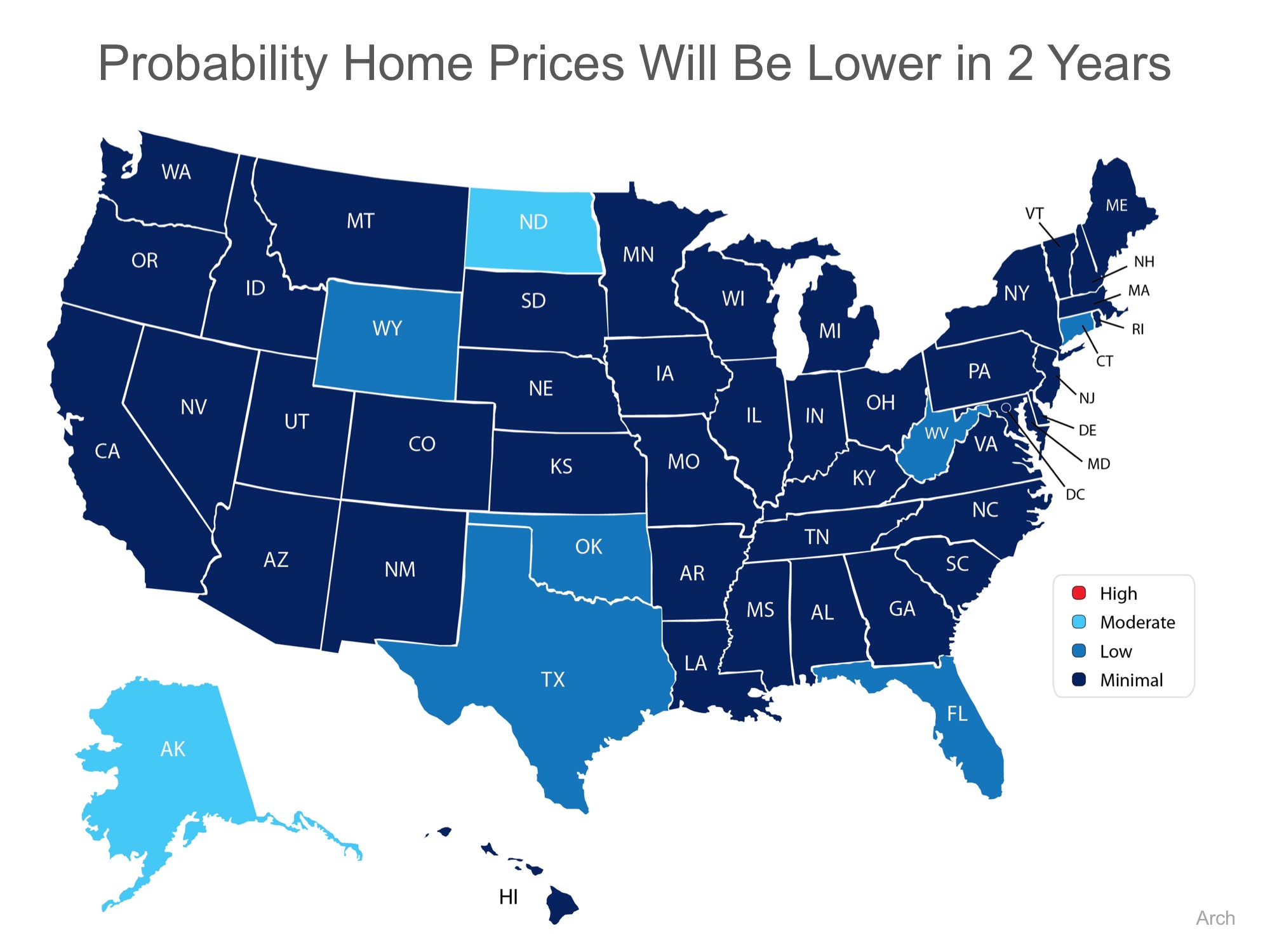
To this point, Arch Mortgage Insurance also revealed their Risk Index which estimates the probability of home prices being lower in two years. The index is based on factors such as regional unemployment rates, affordability, net migration, housing starts and the percentage of delinquent mortgages.

Below is a map depicting their projections (the darker the blue, the lower the probability of a price decrease):

“Short of a war or stock market crash…” | MyKCM

Bottom Line

If interest rates and prices continue to rise as projected, the monthly mortgage payment on a home purchased a year from now will be dramatically more expensive than it would be today.

 
Sascha Chatman
Chatman Realty Group
Fort Worth, TX
(817) 668-0311
Chatmanrealtygroup.com
 
Posted in Market Updates
June 10, 2022

If You’re a Buyer, Is Offering Asking Price Enough?

Schedule With Me
Buyers Guide
Website
Blog

If You’re a Buyer, Is Offering Asking Price Enough?


If You’re a Buyer, Is Offering Asking Price Enough? | MyKCM

In today’s real estate market, buyers shouldn’t shop for a home with the expectation they’ll be able to negotiate a lower sales price. In a typical housing market, buyers try to determine how much less than the asking price they can offer and still get the home. From there, the buyer and seller typically negotiate and agree on a revised price somewhere in the middle.

Things Are Different Today

Today’s housing market is anything but normal. According to the National Association of Realtors (NAR), homes today are:

  • Receiving an average of  3.8 offers
  • Selling in just 17 days

Homes selling quickly and receiving multiple offers highlights how competitive the housing market is right now. This is due, in large part, to the low supply of homes for sale. Low supply and high demand mean homes often sell for more than the asking price. In some cases, they sell for a lot more. Selma Hepp, Deputy Chief Economist at CoreLogic, explains how these stats can impact buyers:

“The imbalance between robust demand and dismal availability of for-sale homes has led to a continual bidding over asking prices, which reached record levels in recent months. Now, almost 6 in 10 homes listed are selling over the asking price.”

You May Need To Rethink How You Look at a Home’s Asking Price

What does that mean for you? If you’ve found your dream home, you need to be realistic about today’s housing market and how that impacts the offer you’ll make. Offering below or even at a home’s asking price may not cut it. In today’s market, the highest bidder often wins the home, much like at an auction.

Currently, the asking price is often the floor of the negotiation rather than the ceiling. If you really love a home, it may ultimately sell for more than the sellers are asking. That’s important to keep in mind as you work with your agent to craft an offer.

Understand An Appraisal Gap Can Happen

Because of today’s home price appreciation and the auction-like atmosphere in the selling process, appraisal gaps – the gap between the price of your contract and the appraisal for the house – are more frequent.

According to data from CoreLogic:

“Beginning in January 2020, nationally, 7% of purchase transactions had a contract price above the appraisal, but by May 2021, the frequency had increased to 19% of purchase transactions.”

When this happens, your lender won’t loan you more than the home’s appraised value, and the seller may ask you to make up the difference out of pocket. Buyers in today’s market need to be prepared for this possibility. Know your budget, know what you can afford, and work with a trusted advisor who can offer expert advice along the way.

Bottom Line

Bidding wars and today’s auction-like atmosphere mean buyers need to rethink how they look at the asking price of a home. Let’s connect so you have a trusted real estate professional who can advise you on the current market and help determine what the market value is on your dream home.

 
Sascha Chatman
Chatman Realty Group
Fort Worth, TX
(817) 668-0311
Chatmanrealtygroup.com
 
Posted in Buying Tips
June 6, 2022

History Proves Recession Doesn't Equal a Housing Crisis


History Proves Recession Doesn't Equal a Housing Crisis


Real Estate with Sascha Chatman

History Proves Recession Doesn’t Equal a Housing Crisis [INFOGRAPHIC]
It’s important to understand history proves an economic slowdown does not equal a housing crisis.
View the Infographic
Thinking of selling?
Download my free eGuide covering the things to consider when selling your house.
Download Now
Thinking of buying?
Download my free eGuide covering the things to consider when buying a home.
Download Now
 
Sascha Chatman
Chatman Realty Group
Fort Worth, TX
(817) 668-0311
Chatmanrealtygroup.com
 
Schedule a "Chat"


REMEMBER:  You can reply back with a video if you'd like by using the button at the top of the page

Free Home Analysis
Seller's Resources
Buyer's Resources
New Construction


Sascha Chatman

Team Leader/REALTOR

Chatman Realty Group

Office: (817) 668-0311

Cell: 817-668-0311

sascha@chatmanrealtygroup.com
Click here to start using Bombbomb!

Facebook Twitter Instagram Pinterest YouTube

The Texas Real Estate Commission requires me to give you the following information:

Information About Brokerage Services

Posted in Market News
Feb. 25, 2022

The 2 Major Buckets that you need before buying a home?

What Are The 2 Major Buckets that you need before buying a home? 

When it comes to buying a home, you need to be equipped and educated with the right kind of information so you’ll have the confidence that you need. Having this type of knowledge helps you to become prepared better financially, especially during the closing day. With that being said, let’s talk about the two major buckets involved when buying a home. A common misconception that I get all the time is, Downpayment Cost and Closing Cost are just the same. It’s not. These costs are two different sides of the coin. That’s why in this blog, I will elaborate on what the difference is between these two things. 


1. The Downpayment Cost. 

First of all, what is the downpayment? Your downpayment is the money that you have to put

up when it's time to buy your home. You don't have to put this money up right away, but you want to have the money because you're going to need it at the closing table. 


Let’s illustrate how much money do you need as a Downpayment Cost.

FHA Loan. 

Let’s say, for example, I was buying a $200,000 home under an FHA Loan, The downpayment for a Home under FHA is 3.5% Which means that you need to prepare at least $7,000 if you want to buy a home with FHA Loan. 


2. Conventional Down Payment

With conventional downpayment, you need to prepare at least 3-10% of the total purchase price of the home. Sometimes, it could go up to up to 20%, but you don't need to put out the whole 20%. 


3. VA Loan

Veterans don’t need to put any money down when it comes to their downpayment.

What’s your next move now?
The first thing you need to do is find a good lender to work with. As soon as you have selected that particular lender, make sure you have an understanding of what your lender’s products are because there are various types of loan products out there that you can choose from. You need to select the best loan products that work for you because some of them might come with higher interest rates.

Posted in Buying Tips
Feb. 24, 2022

The Path To Homeownership Can Be Steeper for Some Americans

The Path To Homeownership Can Be Steeper for Some Americans | MyKCM

As we celebrate Black History Month, we honor and recognize the past and present experiences of Black Americans. A significant part of this experience is investing in a home of their own. While equitable access to housing has come a long way, the path to homeownership is still steeper for households of color. It’s an important experience to talk about, along with how working with the right real estate experts can make all the difference for diverse homebuyers.

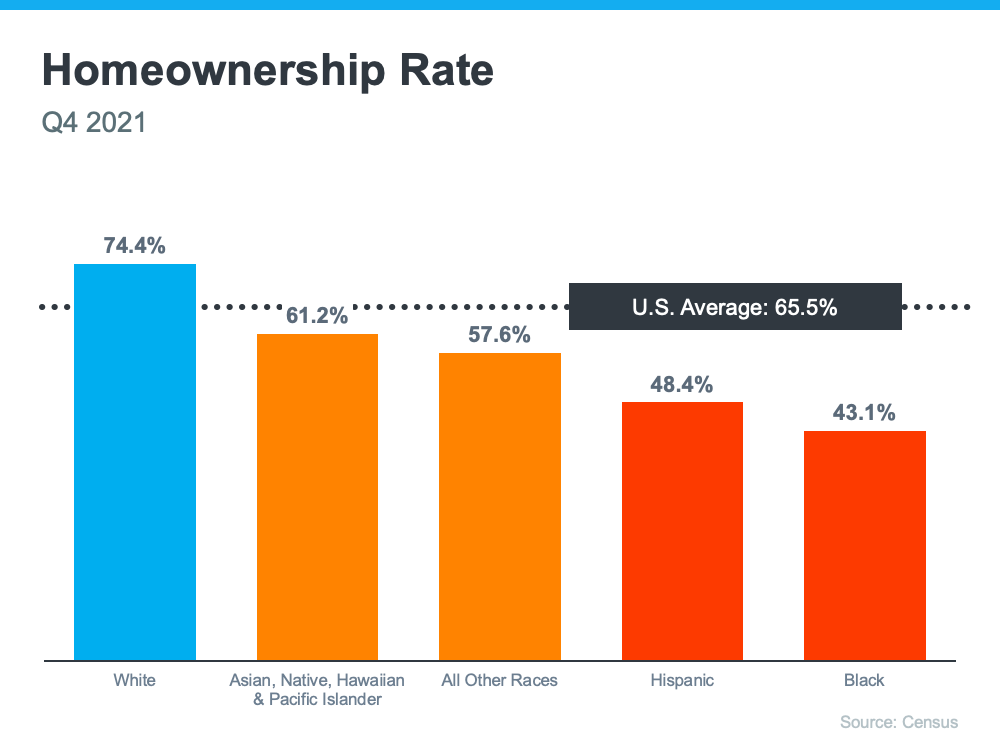
We know it’s a more challenging journey to achieve homeownership for some because there’s still a measurable gap between the overall average U.S. homeownership rate and that of non-white groups. Today, the lowest homeownership rate persists in the Black community (see graph below):

The Path To Homeownership Can Be Steeper for Some Americans | MyKCM

Homeownership is an essential piece for building household wealth that can be passed down to future generations. However, there are obstacles in the homebuying process that can negatively impact certain racial and ethnic groups, including the Black community. This can delay or prevent many from achieving homeownership, challenging their ability to grow their net worth. A report by Vanessa G. Perry of the George Washington University School of Business and Janneke Ratcliffe of the Urban Institute explains:

“. . . households of color have much lower homeownership rates than white households and consequently hold, at the median, just one-eighth the wealth of white households.”

On top of that, when Black households do become homeowners, research shows they pay more for those homes overall than the average household. Raheem Hanifa, a Research Analyst for the Joint Center for Housing Studies of Harvard Universitytells us:

“Black homeowners not only have primary mortgages with higher interest rates than white homeowners with similar incomes, they also have higher interest rates than white homeowners with substantially lower incomes, . . . Black homeowners have experienced systemic barriers to homeownership and wealth-building opportunities that have limited their ability to access credit, which is a key component in receiving low mortgage interest rates.”

For Black homebuyers, the inequity that remains in housing can be a point of pain and frustration. That’s why it’s so important for members of diverse groups to have the right team of experts on their sides throughout the homebuying process. These professionals aren’t only experienced advisors who understand the market and give the best advice. They’re also compassionate allies who will advocate for your best interests every step of the way.

Bottom Line

Opportunities in real estate improve every day, but there are still equity challenges that many face. Let’s connect to make sure you have an advocate on your side as you walk the path to homeownership.

Posted in Market Updates
Feb. 23, 2022

Fix Your Yard’s Drainage Now


Drainage problems can be a major issue for homeowners. Not only does poor drainage cause standing water in your yard, but it can also lead to leaks and foundation problems with your house depending on where the water collects. As if that wasn’t bad enough, landscaping and lawn upkeep becomes a lot harder when your yard doesn’t drain well. Is there anything that can be done about these problems?


Fortunately, yes. There are actually a few different ways to treat drainage issues in your yard, and this is a great time to undertake a project to correct them. By taking action now, you can avoid problems that might arise from heavy spring rains. The exact solution to your drainage issues will depend on the cause of your problem, so here are a few different options to consider.


Grading Issues

One common cause of problems with drainage is inconsistent grading in your yard. This can cause problems if your home is at the bottom of a big slope across your yard, but it can also be an issue if the grading is inconsistent and as a result has one or more low spots in the yard. Water flows along with the soil wherever the grade leads, so this can cause it to collect around your home or in low areas which can then become swampy and overgrown.

Regrading your yard can be done either with specialized tools that scrape soil from higher areas into lower onesv or by bringing in additional soil to completely change the grade. Each method has its advantages, with redistribution being favored when there are both high and low areas in your yard, and the addition of new soil being best when you need to change an otherwise mostly good grade. Once the regrading is finished you can seed the graded area and have grass growing by the time spring arrives.

Soil Penetration

Another big problem with drainage comes when the water simply can’t penetrate down into the soil in time to be absorbed. This is especially problematic because you end up with way too much water in the areas where water collects but the soil in other areas might not get enough. Sometimes this is because the soil has too much clay in its composition so it’s difficult for water to penetrate, and sometimes it’s a result of other issues such as thick thatch. In some cases, it’s even just a matter of the soil being too compacted by traffic and time. Regardless of the cause, though, there are solutions.

Clay-heavy soil is the most work-intensive to correct, but the solution is also pretty simple. You simply need to break up the clay and add soil or sand into the mix to make it easier to drain. Sometimes this is as easy as adding a few holes in the clay-heavy area and mixing it together, especially if the clay is in a relatively small area. In some instances, though, you may need to do some tilling or another heavy mixing to break up larger clay beds.

Other issues can be fixed by using a dethatcher on your lawn to break up the thatch buildup or running tools over the ground that punch small holes to break up overly compacted topsoil. Dethatching and aerating the soil like this are often done together, as the loosening of soil is good for the growing grass as well even if it wasn’t excessively compacted.

"
"
Posted in Home Keppr
Feb. 21, 2022

What Every Seller Needs To Know About Renovating This Year

What Every Seller Needs To Know About Renovating This Year | MyKCM

If you’re planning to sell this year, you’re probably thinking about what you’ll need to do to get your house ready to appeal to the most buyers. It’s crucial to work with a trusted real estate professional who knows your local market to get your home ready to sell. But there are a few things you should consider when deciding what to renovate and update before listing this season. Here are three things to keep top of mind as you’re making your list of projects to tackle this year.

1. The Number of Homes for Sale Is Very Low

Housing inventory sits far below what is normally considered a balanced market. In fact, according to the National Association of Realtors (NAR), the latest data indicates inventory is hitting an all-time low. Because there’s such a limited supply of homes available for sale, you’re in a unique position when you sell your house to benefit from multiple offers and a quick process.

But you want to do so while buyers are still scooping homes up as fast as they’re being listed. Spending time and money on renovations before you sell could mean you’ll miss your key window of opportunity. Of course, certain repairs may be important or even necessary. The best way to determine where to spend your time – and your money – is to work with a real estate advisor to confirm which improvements are truly needed and which ones aren’t likely to be deal-breakers for buyers.

2. Buyers May Be Willing To Take on Projects When They Purchase Your House

Today, many buyers are more willing to take on home improvement projects themselves to get the house they’re after, even if it means putting in a little extra work. A recent survey from Freddie Mac finds that:

“. . . nearly two-in-five potential homebuyers would consider purchasing a home requiring renovations.

If more buyers are willing to tackle repairs on their own, it may be wise to let the future homeowners remodel the bathroom or the kitchen to make design decisions that are best for their specific taste and lifestyle. Depending on the structural condition of your house, your efforts may be better spent working on small cosmetic updates, like refreshing some paint and power washing the exterior to make sure the home stands out. Instead of over-investing in upgrades, the buyer may change anyway, work with a real estate professional to determine the key projects to tackle that will give you the greatest return on your investment.

3. Your Agent Will Help You Spotlight the Upgrades You’ve Made

Over the past year, many people made a significant number of updates to their homes. The most recent State of Home Spending report finds:

“Home improvement spending rose 25% year-over-year to $10,341. Homeowners who invested in home improvement did an average of 3.7 projects, up from 2.7 in 2020, . . .”

With more homeowners taking on more projects in the past 12 months, there’s a good chance you’ve already made updates to your home that could appeal to buyers. If that’s the case, your real estate advisor will find ways to highlight those upgrades in your listing.

The same is true for any projects you invest in moving forward. No matter what, before you renovate, contact a local real estate professional for expert advice on what work needs to be done and how to make it as appealing as possible to future buyers. Every home is different, so a conversation with your agent is mission-critical to make sure you make the right moves when selling this season.

Bottom Line

In a sellers’ market like today’s, it’s important to spend your time and money wisely when you’re getting ready to move. Let’s connect today so you can find out where to target your efforts before you list.

Posted in Selling Tips
Feb. 20, 2022

What do you need to know about Homestead Exemptions in 2022?


Homestead Exemption has changed significantly this year. 

You no longer have to wait to apply for your homestead exemption. In the previous years, you would need to wait to apply for homestead exemptions. You can only apply from January to April. Now you can apply right after you close on your home. All you need to do is update your driver's license to show this is your new home.

The application is FREE!

Yes, you can get the application for free. Your Title Insurance will try to get you paid for it but it is 100 percent, Free 99. You will only need to answer a few questions on there and then you can mail that in with a copy of your driver's license to the county or you can take it down to the county you're in.

Homestead Exemption can actually have a lot of benefits for your new home. 

Once you're a qualified homeowner, it will help perform your taxes increasing more than

10 a year. It also protects you against certain creditors who are trying to take your homestead away from you. Aside from that, you will benefit from not having that huge tax increase like there's a cap on that tax increase. People look at the exemption amount and they freak out by how big that is. Homestead Exemption allows you to get that number down lower.

You don't have to hire and pay somebody else to file for Homestead Exemptions on your behalf.
Once you purchase a home, you're going to get so much junk in the mail and people are

trying to say, “Hey I'll do your homestead exemption for you for $40 and don't even know what they're trying to get people for. I know it's simple to let somebody else do it, but all they're doing is taking your money. They are not applying for your homestead exemption for you, they're just scamming you out of money.


I hope this information is useful in helping you apply for your homestead exemption. If you haven’t done so already, go ahead and reach out to my partner, Bridget Denison and she will happily help you get homestead exemption.

Posted in Buying Tips
Feb. 19, 2022

Millions of Americans Have Discovered the Benefits of Multigenerational Households

Millions of Americans Have Discovered the Benefits of Multigenerational Households | MyKCM

If your needs are changing, you may be thinking about sharing a home with additional loved ones, such as grandparents, adult children, or other extended family members. Whether it’s for financial or health-related circumstances, or simply because you’ve reached a new phase of life, you might be wondering if living with multiple generations under the same roof is a good move for you. Many people have found themselves in a similar situation and they’ve already made the choice to live in a multigenerational home.

What Is a Multigenerational Home?

The Pew Research Center defines a multigenerational household as a home with two or more adult generations. They include households with grandparents and grandchildren under the age of 25. As you weigh your options and decide if multigenerational living is right for you, here's some helpful information highlighted by other homeowners living with additional loved ones.

The Benefits of Multigenerational Living

A recent report from Generations United surveyed individuals living in a multigenerational setting and asked them about the key benefits of this housing arrangement. It says:

Nearly all Americans who live in a multigenerational household (98%) feel their household functions successfully, citing various aspects of home design, family relationships and interactions, and supports and services influencing their success.”

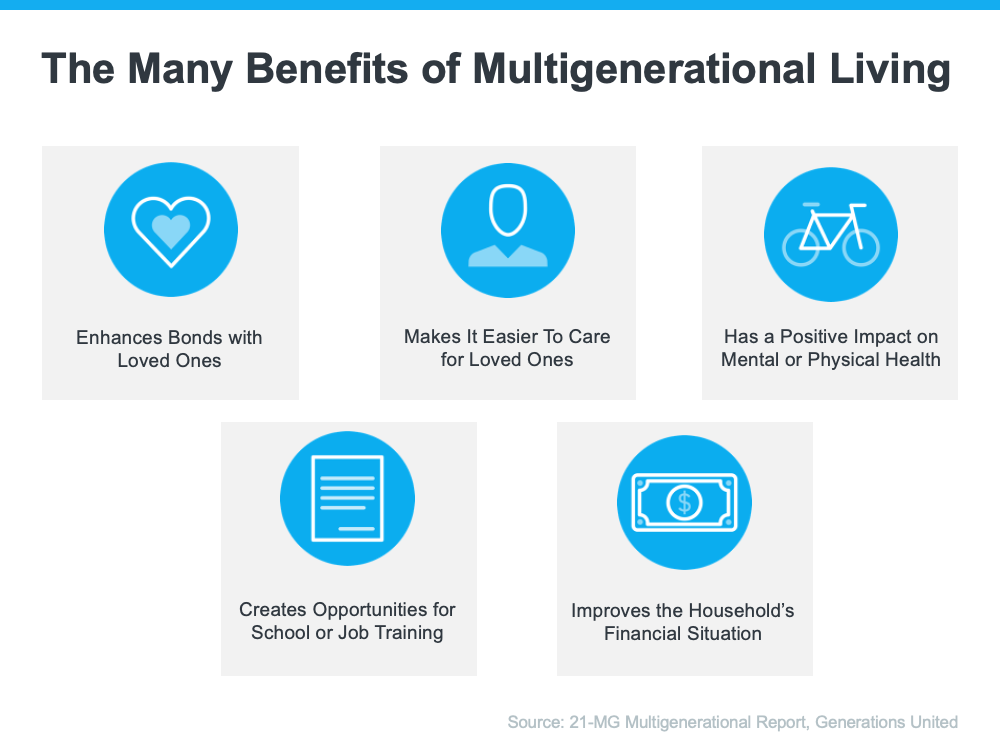
The study identifies some of the top benefits of this lifestyle as an improved financial situation, better mental and physical health, strengthened bonds with loved ones, and more (see chart below):

Millions of Americans Have Discovered the Benefits of Multigenerational Households | MyKCM

Those are just some of the reasons why most people who decide to live in this situation find it worthwhile. As Donna Butts, Executive Director at Generations United, says:

"Families may come together from need, but they are staying together by choice. Indeed, more than 7 in 10 (72 percent) of those currently living in a multigenerational household plan to continue doing so long-term."

With More Adults Living Under One Roof, You May Need More Space

If you decide to look for a multigenerational home, it’s important to understand what everyone will need to make the arrangement work to its fullest. Something that often makes the top of the list for homeowners living with multiple generations is additional space for privacy. This could mean more bedrooms and bathrooms or features like an in-law suite or a basement.

If you’re realizing your current house doesn’t provide the room you need for multigenerational living, an expert real estate advisor can help you navigate the process to find the right home that works for you and your loved ones.

Bottom Line

Living in a multigenerational household has real and impactful benefits. If you’re interested in learning more about these options in our local area, let’s connect so you can find a home that fits your changing needs.

Posted in Market Updates